On this page
Team Building10 min · 12 Nov 2026
Enablers vs. Controllers: Two Philosophies of Leadership
Enablers grow capability, controllers shrink it, and some well-meaning leaders do the shrinking by accident. How to tell which you are, and how to shift.

Geddy
AI Transformation • Full-stack Product Engineering • Leadership
AI-generated content. This article was generated by AI from material I collected and may not be fully reviewed by me. It may contain errors — verify anything you rely on. More in the disclaimer.
TL;DR30 sec
- Every leader secretly answers one question: are my people capable, or do they only succeed when I'm in control? That answer shapes everything else.
- Enablers set direction, hand over whole problems with decision rights, and remove blockers, and Wiseman's research suggests they get roughly twice the output from the same people.
- Controllers become the bottleneck and then complain nobody takes ownership, which is exactly the team their behaviour trained.
- Control isn't always wrong: in a crisis or with new hires, a coach uses it temporarily and hands it back, while a controller makes it permanent.
- Most diminishing comes from good intentions, like the rescuer, the idea machine, or the absent "empowerer" who mistakes leaving people alone for giving them freedom.
- The shift to enabling comes from small, repeated habits: ask before answering, give the pen back, talk last, and judge yourself by what happens when you're away.
If your team only performs while you're watching, you're the constraint, and it's one you can remove.
Every leader answers one question, usually without noticing: are these people capable of figuring this out, or will they only get it right if I'm in control?
How you answer it decides almost everything else about how you lead. It splits leaders into two camps. Enablers hand over ownership and grow the capability around them. Controllers keep ownership close, and the team quietly shrinks to fit.
That shrinking has a name. Liz Wiseman's book Multipliers calls leaders who reduce their people's capability diminishers. Her research suggests enabling leaders get roughly twice as much out of the same people as diminishing ones do. Same team, same talent, double the output. The gap isn't the people. It's the environment the leader builds around them.
The enabler: "People are smart and will figure it out"
The enabler starts from a simple belief: the capability is already in the room. The job isn't to supply it. It's to draw it out, aim it, and get out of the way.
That belief shows up in very concrete habits:
- Sets direction, not instructions. Defines the outcome and the constraints, then lets people choose the route.
- Asks more than tells. Poses hard questions that stretch thinking instead of handing over answers.
- Gives real ownership. Hands over whole problems, decision rights included, not just tasks.
- Debates before deciding. Invites disagreement early, so decisions are understood and owned, not just obeyed.
- Treats mistakes as tuition. Shares their own failures and makes it safe to try things.
- Removes blockers. Spends their authority clearing the path, not guarding it.
What you get is a team that thinks for itself, moves without waiting for permission, and keeps shipping when the leader is on holiday.
The controller: "They'll never figure this out without me"
The controller starts from the opposite belief: intelligence is scarce, and they hold most of it. Here's the uncomfortable part. From the inside, control doesn't feel like ego. It feels like responsibility.
And it shows up just as concretely:
- Gives instructions, not direction. Specifies the how, down to the detail.
- Tells more than asks. Already has the answer and expects others to execute it.
- Keeps decisions close. Decides alone or with a small inner circle, then announces.
- Becomes the gatekeeper. Every approval, merge request, or customer email runs through them.
- Punishes mistakes. People learn that initiative is risky and waiting is safe.
- Jumps in and takes over. Rescues the work instead of coaching, which teaches the team to hand problems straight back.
What you get is a team that waits. The leader becomes the bottleneck, then complains that nobody takes ownership. That complaint isn't a bug. It's the system working exactly as designed.
Side by side
Put the two next to each other and the difference is less about personality and more about where intelligence and control live.
| Dimension | Enabler | Controller |
|---|---|---|
| Core belief | People are capable and will grow | People need me to get it right |
| Direction | Outcomes and constraints | Step-by-step instructions |
| Decisions | Debated, then owned by the team | Made alone, then announced |
| Information | Shared widely by default | Held close, need-to-know |
| Mistakes | Learning opportunities | Proof that control is needed |
| Leader's role | Removes blockers | Is the blocker |
| Team behaviour | Proactive, takes initiative | Waits for approval |
| When the leader is away | Work continues | Work stalls |
| Scales with | The team's growth | The leader's personal capacity |
That last row is the one I keep coming back to. One model scales with people. The other scales with one person's calendar.
Where this fits in leadership research
Enablers and controllers aren't a new discovery. Leadership research has circled the same tension for almost a century. Here's the short version:
| Model | Researchers | Styles | What it adds |
|---|---|---|---|
| Classic leadership styles (1939) | Kurt Lewin, Ronald Lippitt, Ralph White | Autocratic, democratic, laissez-faire | The original control spectrum. Democratic groups did the best work overall, autocratic groups were productive only while the leader was in the room, and laissez-faire groups did least |
| Servant leadership (1970) | Robert Greenleaf | Servant leader | The leader exists to serve the team, not the other way around |
| Transforming vs. transactional (1978, 1985) | James MacGregor Burns, later Bernard Bass | Transactional, transformational | Leading through rewards and rules vs. through vision and growth. Bass showed a leader can be both |
| Situational leadership (1969) | Paul Hersey, Ken Blanchard | Telling, selling, participating, delegating (Blanchard's later SLII: directing, coaching, supporting, delegating) | The right amount of control depends on how ready the person is for the task |
| Six leadership styles (2000) | Daniel Goleman, based on Hay/McBer data from 3,871 executives | Coercive, authoritative, affiliative, democratic, pacesetting, coaching | Coercive and pacesetting styles damage team climate; the other four improve it |
| Multipliers vs. diminishers (2010, revised 2017) | Liz Wiseman | Multiplier, diminisher, accidental diminisher (added in 2017) | Judges leaders by what they do to people's capability. Multipliers get about 2x more out of the same people |
Line them up and the pattern is hard to miss. Lewin's autocratic leader is the controller. His laissez-faire leader is the abdicator. Goleman's pacesetter is also one of Wiseman's accidental diminishers. And situational leadership is essentially the coach: control as a temporary stage, not a permanent state.
What most of these models describe is behaviour. Wiseman adds the effect. Putting both on one picture is what turns a list of styles into a diagnostic tool.
The twist: controlling is a behaviour, diminishing is an effect
It's tempting to stop there: enablers good, controllers bad. But that binary hides something important. Enabler vs. controller describes how you lead. Diminishing describes what happens to your people. And the two don't line up one-to-one.
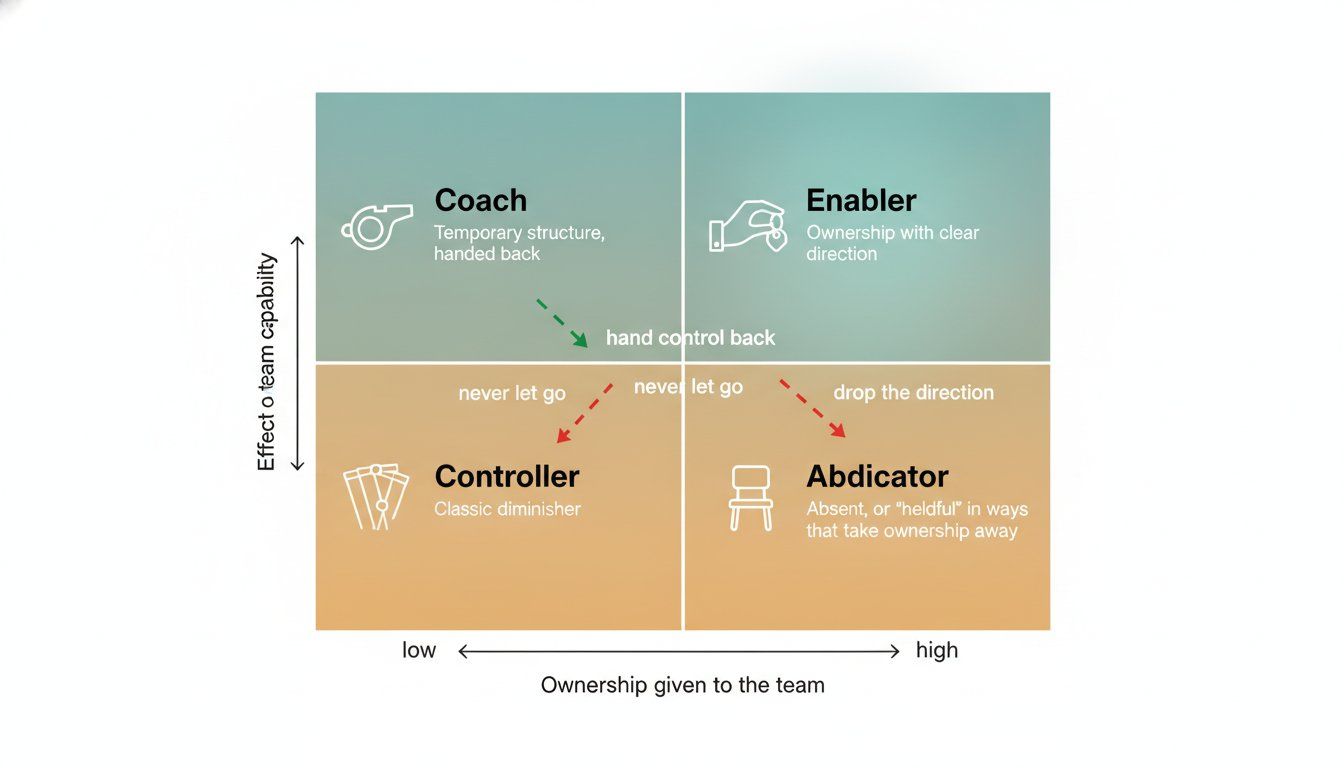
Not every controller diminishes. A directive hand during an outage or someone's first weeks can grow people, as long as the control is handed back. And not every diminisher controls. Some leaders shrink their teams by being too helpful, too fast, or simply absent.
Put the two axes together and you get four leaders, not two:
| Grows capability | Shrinks capability | |
|---|---|---|
| High control | The coach. Structure that's temporary and handed back. | The controller. The classic diminisher. |
| Low control | The enabler. Ownership with clear direction. | The abdicator or accidental diminisher. Absent, or "helpful" in ways that take ownership away. |
The bottom-right quadrant is the one most leaders don't see coming. Low control feels like empowerment. But giving people freedom without direction, context, or support isn't enabling them. It's leaving them alone with the problem. Absence is not empowerment.
The accidental diminisher
The other resident of that quadrant is even sneakier. Most diminishing isn't tyranny. It comes from good intentions, very often from the most capable person in the room. Wiseman calls this the accidental diminisher, and it's a far more common species than the classic control freak.
A few recognisable types:
- The idea machine. Floods the team with ideas, so nobody else's ever get airtime.
- The rescuer. Steps in the moment someone struggles, and takes the learning away with the problem.
- The pacesetter. Moves so fast that everyone else becomes a spectator.
- The always-on optimist. Brushes off real risks, so people stop raising them.
- The strategist. Paints the whole picture, leaving nothing for anyone else to think through.
None of them would describe themselves as controlling. That's exactly why they're hard to spot. The trap is sharpest for strong engineers and other individual contributors who step into leadership. The very habits that made them great — knowing the answer, fixing it fast — are exactly what shrink a team. What used to be your superpower becomes the ceiling over everyone else.
Why control persists, and when it's actually right
If controlling is so costly, why is it everywhere? Because it pays off in the short term. Doing it yourself is faster today. The output matches your standard. You feel safe. The cost is deferred and invisible: a team that never grows, and a leader who can never step away.
To be fair, control isn't always wrong. This is the coach's quadrant, and a firm, directive hand is the right call in a few situations:
- Crisis. An outage or a safety incident needs one clear voice, fast.
- Irreversible, high-stakes calls. Legal, security, or compliance decisions where the cost of error is simply too high.
- Brand-new team members. People need structure before they can use freedom well.
The difference is what happens next. A coach uses control as a temporary tool and hands it back. A controller uses it as a permanent operating system, and that's the moment control turns into diminishing.
From controlling to enabling: practical moves
Nobody flips from one to the other with a title change or a leadership workshop. The shift happens through small habits, repeated until they stick:
- Ask before you answer. When someone brings you a problem, start with "What would you do?"
- Delegate outcomes with decision rights. Say what done looks like, and what they're allowed to decide without you.
- Give the pen back. When you spot a flaw, point to it and let them fix it. Don't rewrite it yourself.
- Talk last in meetings. Your opinion anchors everyone else's. Hold it until others have spoken.
- Make it safe to be wrong. Share your own mistakes, and answer failure with "What did we learn?"
- Remove yourself as a bottleneck. List every approval that waits on you, and hand off at least one each month.
- Stay present while stepping back. Handing over ownership doesn't mean disappearing. Keep the context flowing and stay reachable.
- Measure the team, not yourself. Judge success by what happens when you're away for a week.
None of these are dramatic. That's the point. Leadership style is just the sum of a thousand small reactions.
The real test
A controlling leader's impact is capped by their own capacity. An enabling leader's impact is capped only by the team's growth, and that ceiling keeps rising.
So the test is simple, and it's about the effect, not your intent. Is your team smarter, faster, and more capable because you're there, or only while you're watching? If it's the second, you're the constraint, however good your intentions. And unlike most constraints in your system, this one is fully within your control to remove.
Think about the last problem someone brought to you. Did you hand them an answer, or a better question?
Sources
- Lewin, K., Lippitt, R. & White, R. K. (1939). Patterns of Aggressive Behavior in Experimentally Created "Social Climates". Journal of Social Psychology. Overviews: Simply Psychology, Florida State University
- Greenleaf, R. K. (1970). The Servant as Leader. Background: Robert K. Greenleaf
- Burns, J. M. (1978). Leadership. Harper & Row; Bass, B. M. (1985). Leadership and Performance Beyond Expectations. Free Press. Overview: Simply Psychology
- Hersey, P. & Blanchard, K. (1969). Management of Organizational Behavior. Prentice Hall. On the original model vs. SLII: Tandem Coach
- Goleman, D. (2000). Leadership That Gets Results. Harvard Business Review, March–April 2000. Summary: Doug Belshaw
- Wiseman, L. (2010; revised 2017). Multipliers: How the Best Leaders Make Everyone Smarter. HarperBusiness. The Wiseman Group, Goodreads
Geddy
AI Transformation • Full-stack Product Engineering • Leadership
Engineering leadership • AI innovation • Product thinking. 20+ years of web engineering, from independent contractor to engineering leader. Passionate about developer experience and product engineering.
Follow on LinkedInKeep reading