On this page
AI Strategy9 min · 9 Nov 2026
Integrity Is the New Firewall: Why Values and Critical Thinking Matter Most in the Age of AI
AI makes targeting people cheap. Firewalls don't stop a persuasive message, so firm values and critical thinking may be the security layer we invest in least.

Geddy
AI Transformation • Full-stack Product Engineering • Leadership
TL;DR30 sec
- AI has made targeting cheap, so far more people are now potential targets and potential entry points.
- Technical controls still end at a human who approves, clicks or believes, and that human gets the least investment.
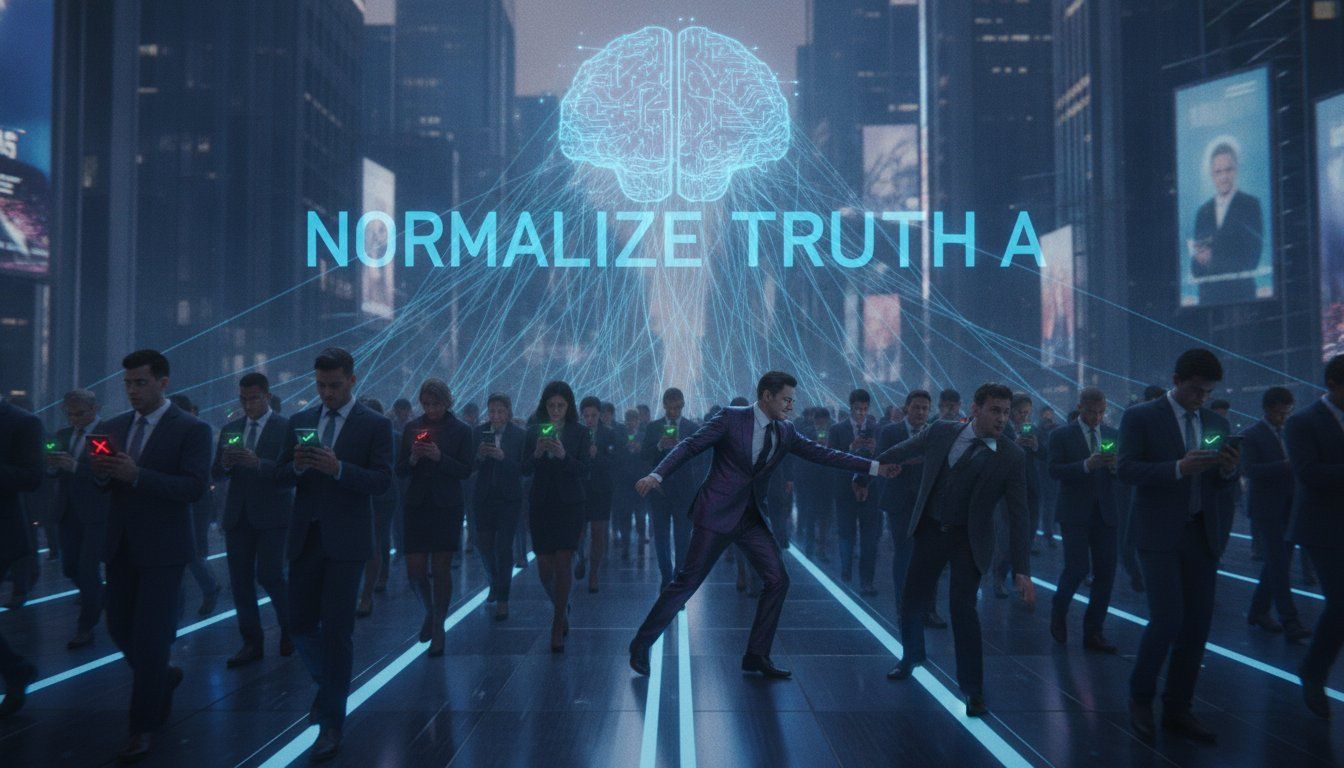
- The bigger threat isn't the spy but the feed: personalised nudges and manufactured consensus can quietly rewrite what feels "obvious" and turn people against each other.
- Integrity works as a real security control: values decided in advance can't be flattered, rushed or bought in the moment, and fewer hidden pressure points leave less leverage.
- Because the feed targets values themselves, critical thinking is integrity's second half: slow down on emotional triggers, verify out-of-band, ask who benefits, and treat AI output as input rather than a verdict.
- Integrity isn't fixed; individuals, teams and leaders can train it deliberately, without sliding into paranoia.
In an age where anyone can fake a perfect message, a person who knows what they stand for is the hardest thing to hack.
For most of the history of security, being a target was a privilege of importance. You had to be worth the effort. Attacks took skill, time and money, so attackers usually picked their battles.
That's changing.
AI has made attack capabilities much cheaper. An agent can research a person in minutes, write a pretext that sounds like your colleague, clone a voice from a podcast clip, scan for misconfigured services and chain it all together with little human help. So the question is shifting from "am I important enough to be targeted?" to something broader. More of us are potential targets, and more of us are potential entry points.
We still need firewalls, MFA, patching and zero trust. But most systems, no matter how well designed, eventually reach a human who decides. Approve. Share. Click. Believe. Comply.
And that human is often the part we invest in the least. Not only as individuals, either. Whole groups of people can now be nudged, at scale, into seeing each other as enemies.
This isn't a call to see a threat behind every message. Most people are exactly who they say they are, and AI is helping defenders as much as attackers. The point isn't suspicion. It's staying grounded enough that the rare bad actor has little to work with.
The human attack surface
Social engineering usually doesn't break systems. It works on people.
It goes after our needs and weak spots: ego, fear, loneliness, ambition, urgency, money, resentment. The "urgent invoice from the CEO", the recruiter who's a little too interested in your current architecture, the new contact who always seems to understand you perfectly.
None of this is new. What's new is the scale and precision. AI can read what you've posted publicly, infer what you care about and where you're insecure, and tailor an approach to you specifically. Not a generic phishing email to a million people, but a personal one to you, written by something that never gets tired.
Even the top of the AI industry is a human target
A very recent example shows how this works at the highest level.
According to the New York Times, as reported by Bloomberg, a US intelligence memo alleged that China's Ministry of State Security recruited Alice Huang, an executive at Singapore-based Nvidia customer Megaspeed, to get close to Nvidia CEO Jensen Huang and gather information on him (the two are not related). The Times reported the alleged aim included pushing for Nvidia's advanced chips to be available in China. Jensen Huang has since admitted to an affair with her and apologised, and Nvidia's board opened an independent investigation, saying it has no reason to believe company secrets or national security were compromised. China denies the allegations, and nothing about her alleged intelligence role has been publicly proven.
I'm not interested in anyone's private life here. I'm interested in the mechanism.
Whatever the investigation concludes, the reported approach didn't go through code or firewalls. It went through a human relationship. If that can be attempted against the most powerful person in AI hardware, AI makes lighter versions of it cheap enough to aim at anyone: an engineer, an admin, a founder, a team lead.
The quieter threat: AI-tailored "common sense"
Most influence isn't a spy, though. More often, it's a feed.
Social networks tuned by AI play a big role in what we see, how often and from whom. One post rarely changes anyone's mind. Thousands of small, repeated, personalised nudges can. Over time they shape what feels obvious. What feels normal. What feels acceptable at work, in politics, with money, in ethics.
That's the part we tend to underestimate. If our values and judgement are mostly borrowed from the feed, they can be gradually rewritten by whoever shapes the feed.
This isn't just theory. The Cambridge Analytica scandal, which broke in 2018, showed that data from tens of millions of Facebook users had been harvested without their meaningful consent and used to build profiles for targeted political messaging. The company openly marketed this kind of influence as a service to campaigns, a story told in the 2019 documentary The Great Hack. How much it actually swayed outcomes is still debated, and some of its claims were likely more sales pitch than science. But it made clear that there is a market for influencing people at scale, and today's tools are far more capable than what existed then.
And now that content can be generated, consensus can be manufactured too. Fake accounts, synthetic comments, deepfaked "evidence". "Everyone thinks this" has become cheap to produce. Our common sense is only as independent as the inputs that formed it.
Sometimes the goal of mass manipulation isn't to convince you of anything in particular. It's to divide. To set groups against each other, inflame disagreements, make neighbours, colleagues and even whole countries see each other as enemies. A society busy fighting itself is easier to influence, slower to act and less able to notice who benefits. Outrage is a powerful fuel, and AI can produce it on demand, tailored to whatever makes you angriest.
The same feeds also connect people and help good ideas travel. The difference is how consciously we use them.
Integrity is a security layer
This is where integrity stops being a soft, HR-poster word and starts working like a real security control.
Integrity, to me, has two parts: values you've decided on, and the judgement to keep them when they're tested. It means acting consistently with those values when no one is watching, and when it would pay not to.
Why does that matter for security?
- Non-negotiable values hold under pressure. It's much harder to buy, flatter or rush someone whose "no" doesn't depend on spotting the fake. You don't need to detect a perfect deepfake if you never move money on a video call anyway.
- Fewer hidden pressure points mean less leverage. Living in a way you wouldn't need to hide leaves an attacker little to hold over you. This is about personal leverage, not confidentiality: credentials and company data still stay secret.
- Values decided in advance beat values negotiated in the moment. Under pressure, with someone charming or urgent in front of you, few of us reason at our best. It helps if the decision is already made.
- Grounded values resist being weaponised against others. Someone anchored in decency, fairness and respect is much harder to push into hatred, contempt or conflict. Divisive campaigns need people willing to see the "other side" as less than human. Strong values refuse that premise.
Technical controls can be bypassed. Policies get "just this once" exceptions. A person who knows what they will and won't do is much harder to move.
Critical thinking protects the values
Values have one weakness: they're exactly what the feed works on. A firewall that can be quietly reconfigured from outside isn't much of a firewall.
That's the second half of integrity. Values tell you what matters. Critical thinking stops them from being quietly redefined.
A few habits I try to keep:
- Ask "who benefits if I believe this?" and "why am I seeing this now?"
- Verify out-of-band before acting on urgency. Call back on a known number. Ask a second person. Go to the original source.
- Treat emotional triggers as signals. Urgency, flattery, outrage and fear are often exactly when to slow down.
- Notice when content seems built to make you hate someone. If a post leaves you furious at a group of people, ask who gains from that anger.
- Step outside your feed. Read the primary source, not the summary of a summary of a thread.
- Be comfortable saying "I don't know yet." Certainty on demand is something manipulators love.
Critical thinking also means not turning into a cynic. Questioning everything isn't the same as trusting nothing. The aim is good judgement, not paranoia, and that includes recognising when something or someone is simply genuine.
This applies to AI itself too. I use AI tools every day, and I find them genuinely useful. But their answers are input to my judgement, not a replacement for it. If we outsource judgement completely, whoever influences the tool can influence us.
Integrity can be trained
Here's the good news: integrity, both the values and the judgement that protects them, isn't a fixed personality trait you either have or don't. It's practised and nourished, like any other skill. The more we train it, the more resilient we become, not only to targeted attacks, but to mass manipulation designed to turn us against each other.
Personally: write down your lines before you're tested. Look back at decisions you regret and ask what pressure got you there. Know your own pressure points, because someone else might be interested in them too.
In teams: hire and promote for judgement and values, not only skills. Make it safe for anyone to say "this feels wrong" without proof. Build verification rituals (call-backs, second approvers) that don't rely on people detecting fakes, because that will keep getting harder.
As leaders: the same rules apply at the top. Executives are high-value targets, and boards should treat executive exposure as a real security risk, not just a private matter that's awkward to discuss.
As builders: engineers, AI leads and founders now hold enormous capability. The same tools can build or break. Our values shape what we build, what data we collect and which corners we refuse to cut. We put a lot of effort into training AI models to follow values. It seems fair to expect at least the same from ourselves.
Character is a differentiator
As capability becomes a commodity, character becomes the differentiator.
Anyone can now generate a near-perfect message, face or argument. What's much harder to generate is a person who knows what they stand for and thinks before they act.
Integrity, meaning values you've decided on and the clear thinking to defend them, may be the most underestimated human trait in the age of AI. It's also among the hardest to fake, buy or quietly rewrite, and it keeps us from being turned against each other. It isn't a complete answer, but in a time of fast change it's a solid foundation to build on.
So here's a question worth sitting with: if someone mapped your pressure points today, what would they find, and have you already decided what you'd do?
← Previous
LLMs, agents & harnesses: platforms, products and setups
Next →
Enablers vs. Controllers: Two Philosophies of Leadership
Geddy
AI Transformation • Full-stack Product Engineering • Leadership
Engineering leadership • AI innovation • Product thinking. 20+ years of web engineering, from independent contractor to engineering leader. Passionate about developer experience and product engineering.
Follow on LinkedInKeep reading