On this page
Mindset3 min · 7 Sept 2026
We're in the age of intellect revolution
I barely write code by hand anymore. Here's why that shift feels less like loss and more like a promotion — if we don't lose ourselves in the process.

Geddy
Senior Web Engineer / Lead
0:00
TL;DR30 sec
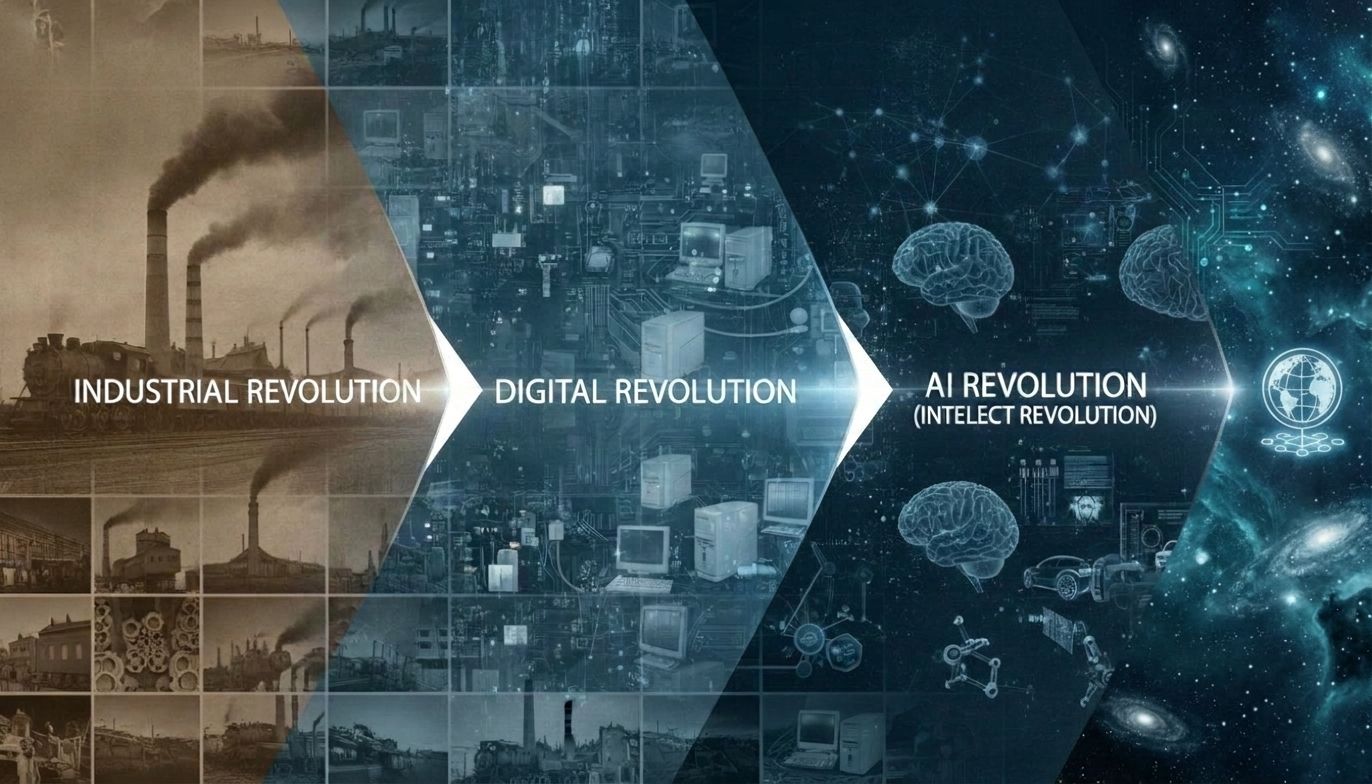
- The industrial revolution scaled our hands and digital transformation scaled our paperwork — AI scales intellect itself, the one thing we assumed was ours alone
- Writing less code isn't a demotion for engineers; it's a promotion into judgement, direction, and owning outcomes
- The real progression of AI usage goes assistive → vibing → environment and rules engineering → interconnected AI ecosystems, and most people stall at stage two
- Repetitive low-interest work shouldn't get faster, it should become irrelevant — that's the actual win
- Intuition, taste, judgement, and human relationships are the skills that compound now, precisely because you can't prompt them
- Speed is seductive and will quietly cost you connection if you don't defend it on purpose
Intelligence scales automatically. Being human doesn't — that part still takes deliberate effort.
I don't write most of the code anymore.
I still read it. I still judge it. But my hands are on the keyboard less than they've ever been, and my brain is spread across business problems, product direction, strategy, system design, user experience, data, intelligence layers — and, occasionally, a simple function.
I sat with that for a moment recently. And I finally admitted something to myself: I've crossed the line from uncertain and worried to inspired and genuinely enthusiastic about what this enables.
We've done this before, but not like this
First there was the industrial revolution. Machines replaced hands.
Then, not so long ago, digital transformation. We went from paper-driven forms to digital interfaces. Filing cabinets became databases. Signatures became clicks.
So where are we now?
AI. And AI isn't about interfaces or automation in the old sense. AI is about intelligence — synthetic intellect.
So here's my conclusion: we're in the middle of an intellect transformation. Though "revolution" is the more honest word.
Look at the progression. People manufactured manually. Machines were introduced. Then the bottleneck moved: we need more intelligent minds to build the next thing. Those intelligent minds built AI.
And now intelligence itself is scalable — outside the physical limits of humanity.
That's the part that should make you stop and think. Every previous revolution scaled our output. This one scales the thing we thought made us irreplaceable.
So what actually matters next?
Here's what I believe, and I hold this one strongly: it matters more than ever to look at who we are.
How we interact. How we build relationships — at work, outside of work, personally. And how we grow the skills that live outside the logical world.
Intuition. Judgement. Sensing. Human relations. Taste.
The stuff you can't prompt.
Because it's incredibly easy to get lost in the pace of this revolution. The tooling changes weekly. There's always a new model, a new framework, a new way to ship faster. And speed is seductive.
But we cannot sacrifice speed for human connection and collective participation in aiming toward shared direction. If we win the race and arrive as people who've forgotten how to talk to each other, we didn't win anything.
That's my subjective opinion. I'm comfortable with it.
My own path through this
I've been actively and closely using AI since the first public releases from Anthropic, OpenAI, and the others that hit general availability.
The progression looked something like this:
Assistive usage. Autocomplete on steroids. Ask a question, get an answer, move on.
Vibing solutions. Letting the model take a bigger swing, then cleaning up after it. Fun, fast, occasionally a mess.
Environment and rules engineering. This is where it got serious. Building the guidelines, the guardrails, the context so AI stays consistent and always context-aware. Less prompting, more architecture.
Building blocks for an AI-driven ecosystem. Where projects can talk to each other. Where a central AI can operate across several systems via MCP, because you instructed it to and it has the context to do it properly.
That last stage is where I spend most of my experimental energy now. And it's genuinely exciting — not because it's clever, but because of what it removes.
Let the boring work become irrelevant
My belief is simple: repetitive, low-interest work should become irrelevant.
Not "faster." Irrelevant.
And what's left for us is the good part. Using our brains and our judgement on outcomes. Validating. Deciding. Choosing a direction and owning it.
That's not a downgrade of the engineering role. That's a promotion — if you're willing to grow into it.
The actual point
This post isn't about business cases. It isn't about features or products or a framework I want to sell you on.
It's a reminder.
We're humans. And we shouldn't abandon being them in this race.
The intelligence is scaling. Fine. Let it. But the connection, the intuition, the trust between people building something together — that doesn't scale automatically. That still takes us showing up for each other on purpose.
So here's my question: as you get faster, are you also getting more human? Or just faster?
Geddy
Senior Web Engineer / Lead
Engineering leadership • AI innovation • Product thinking. 20+ years of web engineering, from independent contractor to engineering leader. Passionate about developer experience and product engineering.
Follow on LinkedInKeep reading